

The Interoceptive Posture Photo (IPP) - Protocol and Rationale
Posted by Steven Weiniger, DC, DIANM on 17th Jun 2026
The Interoceptive Posture Photo: A Biobehavioral Framework for Making Posture Clinically Actionable
Abstract
Postural assessment has long relied on external observation — clinician-rated visual analysis, plumb line measurements, or photographic documentation of static position. While these tools capture morphology, they fail to account for the neurological substrate that actually governs postural organization: interoceptive awareness. This article introduces the Interoceptive Posture Photo (IPP) as a structured photographic protocol that bridges the gap between subjective postural perception and objective postural expression, grounding clinical posture work within a biobehavioral framework for motor control retraining.
The Limits of Structural Assessment
The dominant model in clinical posture assessment has been predominantly mechanical: identify structural deviations, apply corrective interventions, reassess alignment. While this framework has clinical utility, it consistently underperforms in producing durable postural change — a pattern familiar to most practitioners.
The limitation is not methodological but conceptual. Posture is not a static structural phenomenon. It is a dynamic expression of the nervous system's ongoing organization of body segments in gravitational space. The cerebellum, basal ganglia, and supplementary motor areas coordinate sensory input, neural processing, and motor output to produce the postural patterns we observe clinically. Correcting the output without retraining the system that generates it produces transient change at best.
A more clinically durable approach requires integrating the neurological substrate — specifically, the interoceptive mechanisms through which the brain constructs and updates its internal model of body position.
Interoception and Postural Motor Control
Interoception — broadly defined as the brain's representation of the physiological condition of the body — includes the proprioceptive and vestibular signals that inform postural motor control. Interoceptive accuracy, the degree to which an individual's internal representations match their actual physiological state, has significant implications for motor behavior. Poor interoceptive accuracy in the postural domain means the nervous system is organizing movement based on an inaccurate internal map.
This has direct clinical consequences. A patient whose internal sense of "upright" is systematically shifted will resist and habituate away from external postural correction, regardless of its mechanical appropriateness. The correction doesn't feel right — because the nervous system's reference frame is calibrated to a different normal. Lasting postural change requires updating that reference frame, not simply overriding it.
This is the clinical logic of the biobehavioral approach: postural motor control retraining must engage both the behavioral (movement) and biological (neurological) dimensions of postural organization. Interoceptive awareness is the bridge between the two.
The Interoceptive Posture Photo (IPP): Protocol and Rationale
The IPP was developed as a standardized photographic protocol designed to make interoceptive postural accuracy visible, measurable, and clinically actionable. The protocol and its theoretical foundations are described in detail in Weiniger et al. (2024), published in Frontiers in Neuroscience (PMID: 38638696).
Protocol
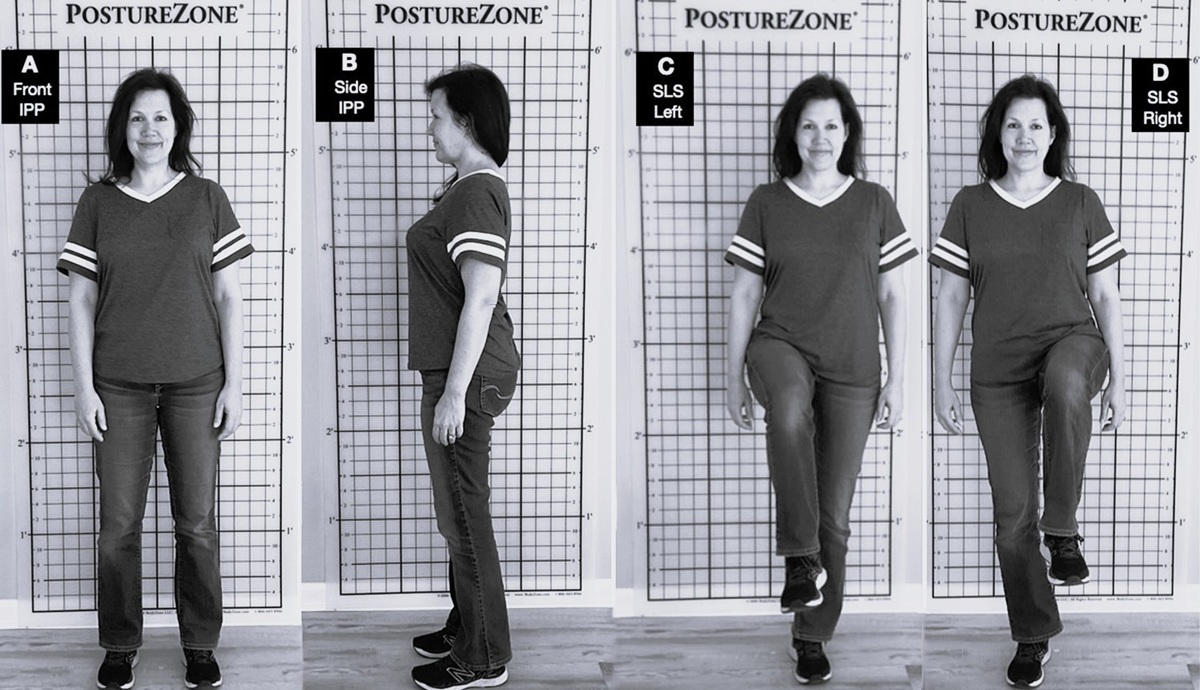
The IPP consists of four photographs:
Bipedal images (×2): Frontal and lateral photographs taken while the patient attempts to stand tall. The instruction — "stand as tall as you comfortably can" — is intentionally non-prescriptive. The goal is to capture the nervous system's spontaneous expression of upright, not a performance of correction.
Unipedal images (×2): Frontal photographs taken in single leg stance (SLS), alternating standing foot. Single leg stance significantly allows visualization of the patient's ability functional patterns of compensation as well as structura adaptations, exposing often concealed asymmetries of postural patterns underlying many motor control issues.
The Grid: A Proxy for Symmetry and the Gravity Line
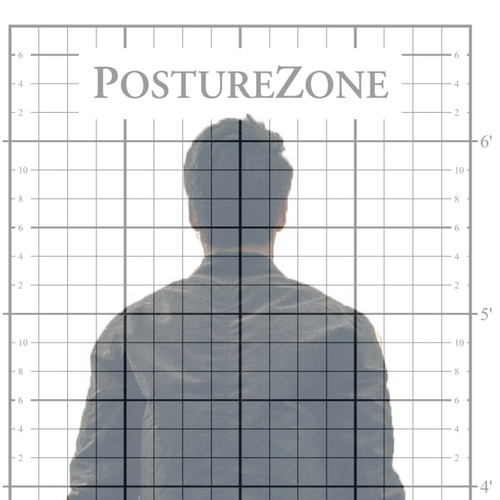
All four images are taken against the standardized, objective background of the PostureZone® grid. The grid isn't incidental — it's a functional essential-clinically for the practitioner, and behaviorally for the person. The fixed vertical and horizontal reference system that serves as a proxy for the gravity line, capturing the patient's center of mass relative to true vertical across each zone of postural mass (the 4 ZPMs- the head, torso, pelvis and lower extremity).
Over time, the grid captures a consistent and measurable background to facilitate objective assessment over time, and document global postural organization relative to gravity of that individual — the clinically relevant variable.
What the IPP Measures
The IPP captures the expressed sensorimotor and interoceptively-influenced postural pattern — specifically, the person's perceived best physical expression of their internal model of upright. Comparing how their perception is expressed with respect to the objective grid reference reveals:
- The degree of alignment or deviation from vertical in each postural zone
- Asymmetric compensatory patterns across bilateral and unilateral stance
- The gap between the patient's perceived upright and their actual postural expression
This gap — between interoceptive perception and objective expression — is the primary clinical variable. Among other variables including proprioception and perceived pain, it reflects the degree to which the nervous system's postural reference frame diverges from mechanical efficiency, and thus becomes a target for biomechanically effective motor control retraining.
Clinical Application: From Benchmark to Retraining
The IPP functions as a baseline benchmark rather than a diagnostic endpoint. Its clinical value is as the starting point for a structured motor control retraining protocol, used to:
- Establish interoceptive baseline. The IPP documents the patient's current interoceptive reference frame — where their nervous system believes "standing tall upright" to be — before any intervention. Processed in the insula, a deep brain structure, addressing interoceptive sensory input is usually not factored into care, and is a neglected factor in the neurological and biomechanical expression of posture.
- Generate patient insight. Showing a patient the gap between their perceived and expressed posture is clinically powerful in a way that verbal correction is not. The moment of recognition — "I thought I was standing straight" — disrupts the patient's habituated internal model and creates neurological receptivity to retraining. This is a biobehavioral mechanism: changing behavior requires first making the behavior visible, and the sensory mismatch salient.
- Guide exercise selection. Subtle asymmetric patterns revealed in unipedal IPP images directly inform StrongPosture® protocol selection, identifying which postural zones and movement patterns require prioritized retraining.
- Track interoceptive change Serial IPP assessment in a care over time enables tracking of changes in postural expression over time. Rather than simply structural change, an IPP provides objective documentation which reflects the broader neurological retraining process.

Implications for Practice
Framing posture work within a biobehavioral model — with the IPP as the primary assessment tool — shifts the clinical conversation in two important ways.
First, it repositions the goal of intervention. The objective is not to reduce a postural deviation, the expressed postural assymetry or motor pattern; it's to retrain the nervous system's organization of movement. This distinction is clinically significant: it changes what we measure, what we prescribe, and what we communicate to patients- for our care, and their compliance with home exercise and activities of daily living (ADLs).
Second, it provides a mechanism for durability. Structural corrections are subject to the nervous system's continuous recalibration toward its established reference frame. Retraining that reference frame — improving interoceptive accuracy — produces change that the nervous system actively maintains rather than resists.
For practitioners working within chiropractic, physical therapy, or integrative rehabilitation, the IPP offers a standardized, evidence-referenced tool for operationalizing this approach in clinical practice.
Conclusion
The Interoceptive Posture Photo represents a clinically practical application of interoceptive neuroscience to postural assessment and motor control retraining. By making the gap between perception and expression visible, it grounds posture work in the neurological substrate that actually governs postural organization — moving the field from structural correction toward biobehavioral retraining.
The grid is not just a background. It is a reference for gravity. The IPP is not just a photo. It is a window into the nervous system's postural map — and the starting point for changing it.
LEARN MORE about Biomechanics & Interoception: A Biobehavioral Approach
Reference
Weiniger S et al. "Interoceptive posture awareness and accuracy: a novel photographic strategy towards making posture actionable." Frontiers in Neuroscience, 2024. PubMed: https://pubmed.ncbi.nlm.nih.gov/38638696/ PMC Full Text: https://pmc.ncbi.nlm.nih.gov/articles/PMC11025613/
Dr. Steven Weiniger, DC, DIANM, is the founder of StrongPosture®, CPEP® Posture Specialist Certification, and CEsoup continuing education. He is the author of Stand Taller Live Longer: An Anti-Aging Strategy. Learn more at StandTallerLiveLonger.com.